Gaines Group Architects has elevated four new partners to the leadership of the firm: James Halstead, Deborah Smith, Adrienne Stronge, and Paul Tassell. They join Raymond Gaines and Charles Hendricks in the leadership of the firm. Raymond founded the business in 1987 and Charles joined as a partner in 2008. This leadership expansion provides resiliency and stability. Charles says, “This is a huge step forward for the business allowing us to better serve our communities. I am very excited to continue to work with each of our new partners for many years to come. Ray has set up an incredible partnership model for how to do business as friends while serving others. This was an obvious next evolution for the firm.”
About the firm: Gaines Group Architects is a firm that has a commitment to designing for the future. We have assembled a remarkably talented and experienced team of professionals to pull all building elements into a single elegant and functional design. Integrity, budget control, effective and timely communication, and a thorough knowledge of current technology, construction methods, and materials turn our promise and your dream into a delightful reality.
Mission statement: Gaines Group Architects is committed to designing for the future and having a positive impact on the lives of the people who live and work in the communities we serve.
Why we do it: Because we want our clients to have comfortable beautiful healthy spaces to live, play, and work.
Charles has the pleasure of speaking about building science and sustainable design in a variety of venues and to diverse groups of people. His years of experience speaking on these topics has given him an insightful perspective on the future of sustainable design and building. Below, he shares his thoughts on the future and the hope he feels in the progress to be made.
Charles discussing sustainable design to a group at VMRC.
I have been on a “lecture circuit” discussing building science and sustainable design since 2005 when I designed what would become, one of the first LEED Certified homes in the country. Ray Gaines is the architect of record for that project and our entire team was part of the process. As I continue to learn more about sustainability including the economics of climate change, I evolve in the knowledge I am capable to share. However, the building science basics have not changed in all that time. We have seen tremendous progress in what we can achieve in energy efficiency and healthy indoor environments, new products have entered our market to make some things easier, and we have found more and more demand for healthy, energy-efficient, and durable design solutions. The only thing that remains constant is the building science.
One of the key things to understand when talking about sustainable design comes from a phrase I heard many times while attending UVA to study architecture: “We have not learned how to be good, just less bad.” The inherent nature of creating places for us to live, work, play is that we have a negative impact on the environment that existed before we got there. We dig a hole, use chemicals, cut down trees, use valuable resources to create and define a space. Don’t get me wrong, we have come a very long way since I began learning about sustainable design. Our solutions today are tremendously better than what we were doing in 2000 or even in 2005 when we used LEED for Homes to measure our success. We have better products that are softer on the environment. Our buildings are even more energy efficient. We better understand how to minimize our carbon footprint. We know how to better manage site disturbance. However, at the end of the process we are still not creating healthy regenerative environments that benefit the overall environment. Ultimately, we continue being “less bad”.
I think there is certainly hope for a future where we can build regenerative environments to live, work, and play. I see glimpses of it now with clean energy installations, vegetative walls and roofs, and biophilic design strategies. I see our industry moving towards holistic design solutions that acknowledge our contribution to climate change and environmental degradation and a desire to fix our problems. The AIA code of ethics in fact demands that all architects take up this challenge and design better and more holistic solutions. Even the building code minimums that we see numerous buildings built to meet has embraced the need for energy-efficiency to our carbon emissions.
While we have no shortage of challenges ahead, I see many that are rising to meet them. I see architects coming together to figure out best practices and understand building science. There are new products coming to market that embrace a healthier future, some will work, and some will not, but we have to test and experiment to find the right path. I see hope in the generations ahead and their desire to take on these challenges and solve some big problems in new, inclusive, and holistic ways. We are moving in the right direction, slowly, but we are still moving.
We hold to our belief that it requires action, time, and energy to build a stronger, more vibrant community. Community has many scales and our collective actions create a ripple effect. Last week Charles had a full schedule of events and he was reminded of the value each of us plays in serving our community. He attended his regular Tuesday morning Rotary Club of Rockingham County meeting which focused on Polio vaccinations around the world. This terrible disease is very close to eradication but simultaneously on the brink of another worldwide outbreak. The work of Rotarians to raise awareness, money, and to take action has made a significant difference with now only two countries in the world reporting wild Polio cases. As an aside, there has been a minor outbreak in a small community in New York, but it is not reported as a wild outbreak. These cases in New York remind everyone of the critical importance of vaccinations.
After Rotary, Charles headed South to Mary Baldwin University to talk sustainability with business majors. The first class he participated in consisted of freshman students who were eager to discuss and learn how an architect applies sustainability to their work. The excellent conversation and questions showed these students have deep desires to understand the impacts business has on the environment how they can be a part of creating a better future for everyone. The second class was a small group of students who have a primary focus and deep understanding of sustainability in business. The conversation was focused on how to build a sustainable business using the three principles of sustainability; people, planet, and profit.
Charles hit the road after meeting with the MBU students and went directly to Eastern Mennonite School for a second day of teaching Sketch Up and floor plan creation to high school students. The class is tasked with designing a 900 square foot house with 1 bedroom and 1 bathroom as a tool to learn this software and create three dimensional spaces.
To round out his day of service, Charles participated in a spirit night that he helped organize at Harmony Square Dairy Queen. Named “Pints for Polio” this twist on a traditional fundraiser is an annual event that raises Polio awareness in a family0friendly environment.
Not all of our days can be this jam-packed with community service, but is not lost on us how it takes many hands and willing hearts to intentionally build a better, stronger, more vibrant community.
Charles with students from Eastern Mennonite School picking up trash.
It was a busy weekend for Rockingham Rotary Club and Eastern Mennonite School’s Interact Club as they teamed up to pick up trash along Rt. 42 in Rockingham County. As a sponsor and liaison between these two clubs, Charles helps these clubs collaborate on projects. This clean up effort happens twice a year and and is necessary for keeping our community clean. The sunshine and cheerful volunteers made this weekend’s cleanup extra special!
The work of Rotary is known around the world for putting service above self. This organization’s main work is to eradicate Polio worldwide, to build friendships through service to the community, and to make the world a better place. Charles says that seeing the energy and enthusiasm of the Interact members inspires him to do more service for the community. If you want to be involved in serving your community or have a potential service project, feel free to reach out to Charles to learn more about the power of Rotary or learn more here and here.
Later into the weekend, we were thrilled to join the 10th Anniversary celebration of the Scholars Latino Initiative. This organization goes beyond an after-school program or mentor pairing system or college preparation group. SLI is a family that supports each other to help fulfill dreams, break down barriers, share frustrations, and achieve goals. Their mission reads “Scholars Latino Initiative supports Latino/a/x high school students with college access through rigorous academic challenge, leadership development, scholarships, and supportive mentorships.”
The celebration last night was filled with fun and friends as well as incredible Latino inspired foods. There were celebrations of past successes and reunions of old friends. Lua Project played a fusion of Appalachian and Latino music and the medleys were magical.
The important work being done through SLI is critical for our community. We all need to come together to help one another and those that are the most marginalized need systems in place like SLI to find their full potential.
Congratulations on 10 years, we look forward to the next decade.
As architects and designers, we find ourselves oscillating between a larger, holistic view of design one minute, and then headfirst into the details a moment later. We must be adaptable and open to looking at each project through both lenses individually and simultaneously. I recently sat down with Charles to talk through this concept of how we approach design and asked him a few questions. Follow along below to learn from our conversation.
Charles, what does it mean to you to approach a design holistically?
We get calls all the time with the same question: “how much for you to design a 3 bedroom house in the county?” I see this question as an opportunity to talk about custom design vs new construction. Many homes and even businesses are not designed holistically, they are just drawn to look like a certain style. When we take on a project we want to approach it with more than just the facts (3 bedrooms, 2 bath, kitchen with window above the sink – check). We want to think about how the building sits on the site, frames views, how it performs over time, and how it impacts the environment. A holistic approach to design asks questions about the life the inhabitants want to live in that place and not just the budget, square footage, and the number of bedrooms. We want to not only hit the budget with our designs, but we also want to enhance livability with our custom solutions that are environmentally sensitive, durable, and healthy.
While it is important to think holistically, we know details are what can really set a design apart. How have you trained yourself to approach a design through both lenses?
We are always looking for those special opportunities and challenges to make a project, detail, or design solution unique. As an architect, you are constantly zooming into a small detail and stepping back to see the whole picture. If you don’t you will not be able to think through all the elements that make up a good design solution. It is important to keep the overall goals in mind even when working on the very small details so that everything is coordinated in the end.
Do you prefer to spend your time on the details of a design, or are you a larger-picture/holistic thinker?
I have done both over my career, but where I am at now, I deal with the holistic a lot more. I have an amazing team of talented architects and designers that work into the details and then we discuss them. So I still get to enjoy the detail, but I don’t get to spend a lot of time on them.
What are some of your most memorable design details to date?
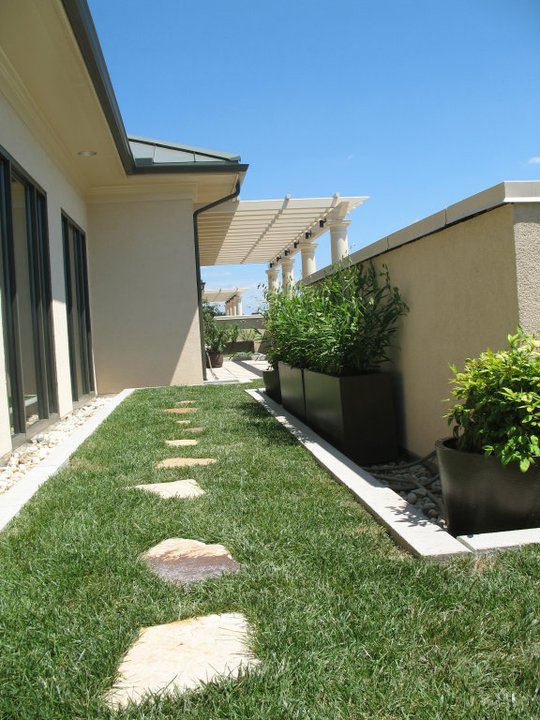
I have so many amazing clients that have allowed us to design for them over my 23+ years doing architecture. The rooftop deck on East Grattan Street and all the small special spaces and elements in that house are very cool. The painted address on Duke Garden apartments came out better than I expected. The sign in front of the Depot that pays tribute to the railroad is one of my favorites. The views we framed on top of Afton mountain are amazing. The playhouse I designed for my girls is one that holds so many special memories. The first LEED-certified project I completed way back in 2005 that has the look of a much older home will always be one of my top projects. There are simply too many options to pick just one. From the half-wall shadow detail we have used to the lambs fence for deck rail to the glass walls into a mechanical room at the elementary school so kids understand the building systems we have used many opportunities to create details I am proud of over my career.
University of Miami life has included a few fun days at Key Biscayne, a lot of late nights in the architecture studio, and a ton of thinking about my future career as a licensed architect. Despite only being a rising third year at the University of Miami’s School of Architecture, I have found myself frequently wondering what it is like to be a real architect. Throughout my two years of school, I have learned software after software, great design skills, and how to make a snazzy layout for a final pinup, but I had not exactly grasped what day-to-day life is like for a licensed architect working in a firm. I wanted more information and experience so I started looking for opportunities.
A job shadowing position at Gaines Group Architects was the perfect answer to my question. I met with my mentor, Charles Hendricks, for two and a half months over the summer. I currently live in Miami, so going to the Virginia-based firm in person was not an option. Charles and I worked out an option to do a virtual job shadowing position where I could get a glimpse of his current projects and design a new project of my own. I met with Charles on Zoom (link to zoom website) once a week and was able to receive invaluable feedback on my design while gaining insight into his responsibilities as the principal architect at Gaines Group Architects.
I have been interested in architecture since I was young. Whether I was designing houses on Minecraft and The Sims or printing out blueprints and drawing over them, I was always finding ways to create and design. The first time I met Charles was over two years ago when I was deciding whether or not to major in architecture in college. Charles told me getting an architecture degree would not be easy and is accompanied by a lot of late nights, but it is worth it if architecture is what I truly enjoy. After that conversation I knew architecture was the major for me, even knowing it is challenging.
Now, speaking as someone with two years of a degree under her belt, architecture school is the hardest thing I have ever done. I have Studio, my main class, for three hours every other day. Honestly, studio controls my life. Once the class is finished, I stay in the studio and continue to work all day, otherwise, there is no way I will get to bed before 4 a.m. Weekends are reserved for projects, not partying. Getting an architecture degree takes discipline, but I am able to make it through because I love the work I am doing. If I could give one piece of advice to someone considering going to architecture school, it would be to only go into this degree if it really captivates your interest and is something you could work on consistently for hours every single day. Yes, architecture school is hard, but it is the only way to become an architect, so it is worth it to me.
When Charles offered me a virtual job shadowing position for the summer, I was very eager to take advantage of the opportunity to learn more about architecture post-college. College architecture is all that I know, and although the degree is designed to prepare me for life after graduation, I still was not sure what it was like to be an architect working in a firm. A lot of the designs we do in college are not geared toward real-life clients, so it was hard to imagine designing catered to others’ wants and needs versus my own. For the job shadowing position, I decided to design my parents’ future home that they will be constructing in around five years. This project was the perfect way to experience designing something with real clients, but the clients are my parents, so it is okay if I mess up. I also took on the task of learning and using software I had never used before. Charles informed me that at his firm they use #SketchUp for 3D modeling. At the University of Miami, we use either Rhinoceros 3D or #Revit for digital model making, but I had heard before that Sketchup is a more commonly used software in firms, so I figured this summer would be a great time to learn, especially with Charles assisting me along the way.
Charles suggested the first step in this project be a #Zoom meeting with both of my parents, where I interview them as the “principal architect” and ask questions regarding their vision for their future dream home. Charles was very helpful in this process; he gave me a list of topics to discuss with my clients that allowed me to understand what sort of questions I will be asking my clients in the future.
My parents wanted a Pacific Northwest-style home with three bedrooms, three and a half bathrooms, an open floor plan, large living spaces, and kitchen, and most importantly, a giant covered porch. The house is going to be built on my parents’ land, so my next step would be to visit the site in person to get a feel for the topography and areas with the best views. Since I am in Miami, I could not visit the site myself. Thankfully, Charles was able to meet with my parents and visit the site, so then he could explain to me where and how the house should be positioned to warrant the best possible views of the property. The site is sloped, so I had to overcome the challenge of designing a home on a hill, which is obviously not a design issue I experience in Miami. Additionally, because I was unable to see the site in person, it was difficult at times to understand important design-affecting elements, such as how steep the incline of the land is and the location of the existing driveway in relation to the site. Charles helped me through these challenges and gave me great insight as to how to design a home with a sensible layout that is also in-budget, structurally sound, and up-to-par with my parent’s stylistic requirements.
I started my design process with sketches and drafts of floor plans and elevations. Through the drafting stage, I learned a lot about how to stay on budget and how particular elements like having a lot of angles, too spread out of a floorplan, or a complex roof can quickly make the cost of the building increase. I learned to simplify and condense design elements to fit my parents’ budget, which is something I have not had to do in college architecture due to the fact that we are not designing for a real client with a real budget.
After I had a more solidified floor plan, I used AutoCAD to further its development. I found it very beneficial to have “clients” to reference when I had a particular design question. In architecture school, the student makes all the design decisions and caters the project to his or her own desires, but for this project, I got a taste of what it is like to design for somebody else rather than myself. I was able to ask my clients what they exactly wanted, so essentially the clients were making all the tough decisions for me.
Next, I brought my floor plans into SketchUp and began 3D modeling. SketchUp was far more user-friendly than any other 3D modeling software I have used, so I had a great time playing around with the form of the house and making changes to the floor plan accordingly. I found it to be much easier to quickly go from an incomplete model to a finished model with materials and landscaping in SketchUp than it is in any other 3D modeling software, so I am very grateful Charles suggested I learn the program. Additionally, I now have another skill to add to my resume and another unique design piece to add to my portfolio.
As part of this job shadowing experience, I also got an inside look at what Charles is working on and the sorts of projects he receives at his firm. It was very interesting to see the grand scope of projects he is juggling all at once, from a giant book warehouse to a bagel store to a gorgeous home. I realized that architecture can be whatever I want to make it in the future, and I can specialize in literally any field of architecture I desire. I also realized that it gets better. Architecture is not an easy profession by any means, but at least it seems that the all-nighters will stop after college.
Getting an architectural degree can feel defeating at times, but this job shadowing experience gave me hope for my future as a licensed architect. I would recommend anyone considering majoring in architecture, or even already working on their architecture degree, to job shadow an architect. I gained so much from my job shadowing experience: I learned new software, received amazing feedback on my own work, gained insight into the work and daily life of a busy architect, and designed a dream home for my parents. Thanks to Charles and Gaines Group Architects, I can now picture my future as a working architect and I am looking forward to it more than ever.